March 23, 2026
BC Crane Safety Newsletter
SPRING 2026
Spring Start-Up Preventive Maintenance
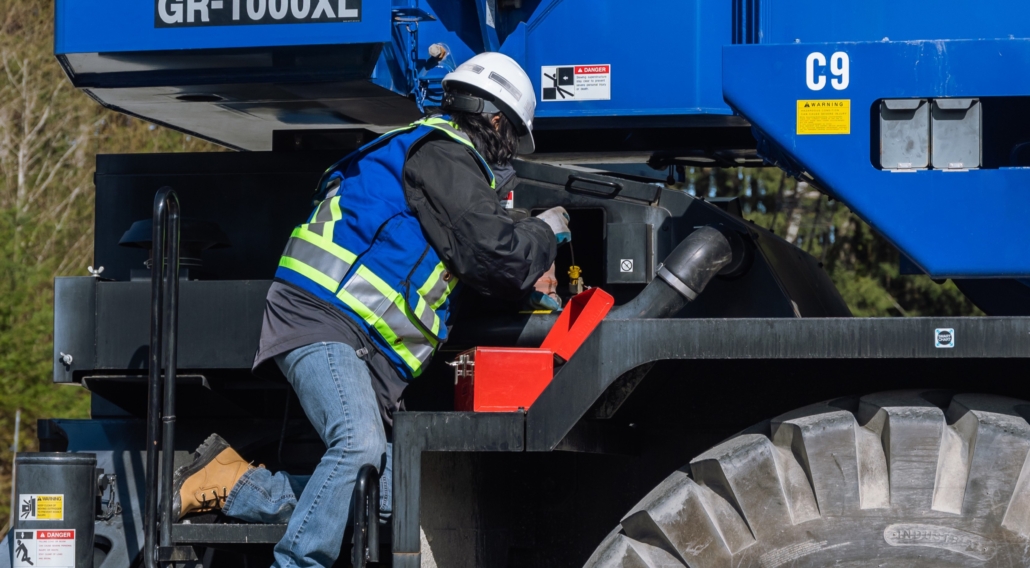
Spring is a crucial time to ensure your equipment is safe and ready for the busy season ahead.
Winter doesn’t just leave grime behind. Snow and rain can significantly increase moisture exposure, and when that moisture combines with salt and freeze-thaw cycles, it can accelerate corrosion and trigger electrical and control problems.
A thorough preventive maintenance inspection after winter’s harsh conditions can prevent costly downtime and safety incidents.
Key areas for your spring start-up inspection:
- Combat corrosion:
Inspect all structural members, pins, fasteners, and electrical enclosures for damage from winter grime and road salt. - Manage fluids and filters:
Verify and replace hydraulic, engine, and gearbox fluids and filters. Crucially, check for water contamination resulting from freeze-thaw cycles. - Test electrical and controls:
Assess battery health, clean ground points, look for damaged cables, check for connector moisture, and diagnose any sensor faults.
Build Your Own Inspection Plan
If you’re looking to create, review, or tweak your existing preventive maintenance program, be sure to visit our Crane Preventive Maintenance knowledge base page.
Rigging, Hoisting, and Lifting in Alberta: Visioning & Strategizing Summit
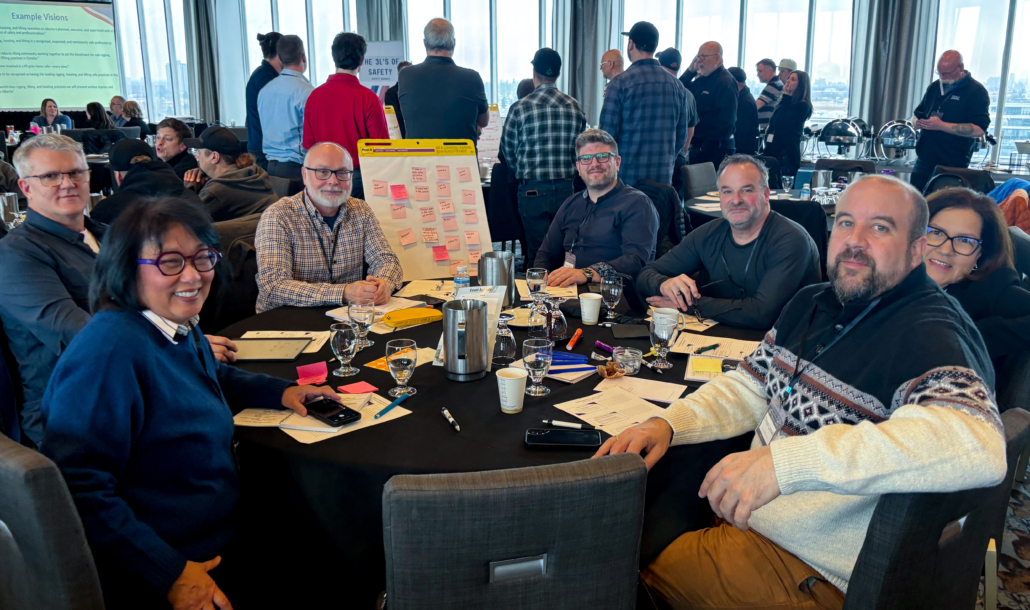
Leaders from across Alberta’s rigging, hoisting, and lifting community came together for a full day of collaboration aimed at shaping the future of the sector.
The program opened with context setting and recent updates from key contributors, including:
- Thomas O’Neill, University of Calgary
- Lisa Pollio, Energy Safety Canada
- Sean Hlushak, SAIT
- Rick Sikora, Cranemasters
Participants engaged in visioning exercises, working through breakout discussions and plenary dialogue to develop an interim “North Star” vision for a proposed Alberta Society for Rigging, Hoisting, and Lifting.
The group then turned to identifying strategic themes—the critical areas of focus and potential workstreams that could guide the society’s early direction and inform the formation of future committees.
A governance dialogue led by Thomas O’Neill outlined the requirements for registering a new society in Alberta and the administrative steps needed to get started. Attendees were invited to consider putting their names forward for board nominations, with the call for interest remaining open following the event.
The session wrapped after a productive day dedicated to strengthening collaboration and elevating standards across the province.
DACUM Review: B.C. Rigging Competencies
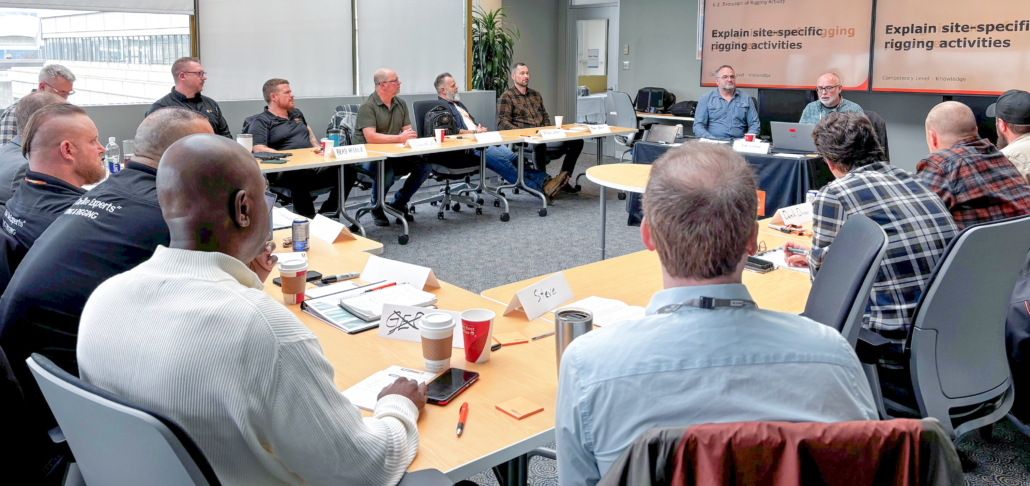
BC Crane Safety members Trenton Grover and Roberta Sheng-Taylor participated in WorkSafeBC’s Rigging Competency workshop, contributing subject matter expertise to a review of more than 90 tasks outlined in the WorkSafeBC DACUM (Developing a Curriculum) chart for rigging operations.
WorkSafeBC provided an overview of the sources informing its draft rigging competency framework, which draws on Canadian standards aligned with ISO certifications, government funded competency initiatives, and safety critical requirements. The framework also reflects insights from industry training programs, WorkSafeBC safety materials, and B.C. occupational health obligations.
To ensure robustness and alignment, WorkSafeBC benchmarked the draft competencies against provincial and U.S. regulatory requirements, B.C. specific rigging rules, and a range of publicly available course outlines and instructional manuals.
This collaborative review supports ongoing efforts to strengthen rigging competency expectations and harmonize approaches across jurisdictions.
Preventive Maintenance Starts with Better Records
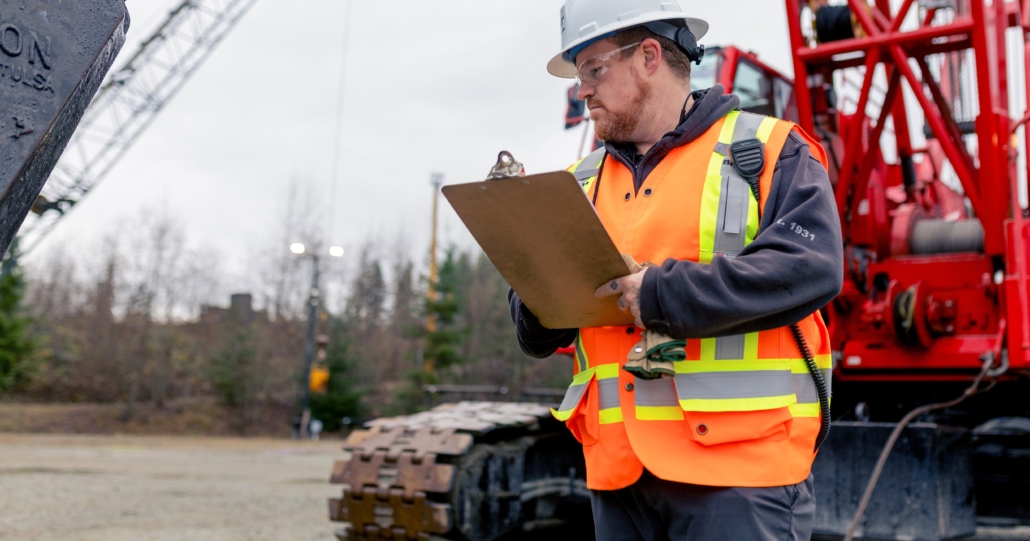
Your equipment logbook is more than a compliance checkbox—it’s the foundation of a truly preventive maintenance program. When inspections are documented thoughtfully, patterns emerge, failures are anticipated, and downtime becomes optional.
Crane logbooks have shifted from “paperwork” to a core part of preventive maintenance—especially as some jurisdictions update occupational health and safety requirements to reference newer editions of Canadian Standards Association CSA Z150 Safety Code on Mobile Cranes.
In Crane & Hoist Canada’s Levelling Up Your Logbooks, Jason Brown of Kova Engineering explains how annual engineering sign-offs increasingly depend on verifying documentation and not just inspection findings.
Missing information, gaps in history, or incomplete records now routinely delay certification and lead to costly downtime.
A strong logbook tells the crane’s full maintenance story. It should be permanent, traceable through the crane’s entire service life, and always accessible when the crane changes job sites or owners. Every defect should be closed out with follow‑up notes showing what was repaired or adjusted, who performed the work, and the return‑to‑service confirmation.
Generic pass or fail forms are no longer enough. Machine‑specific checklists based on the manufacturer’s manual and the applicable standard are now the expected baseline. Better records mean fewer surprises, smoother certifications, and stronger due diligence.
A Strong Logbook is Your Best Preventive Tool
A strong logbook:
- Closes the loop.
A preventive program isn’t complete until every finding is traced to its corrective action, technician, and final return‑to‑service confirmation. - Creates a living history.
Gaps in records, like a missing 10-year boom teardown, are now major red flags that stop certification. A complete logbook provides the evidence that long-term preventive measures were actually performed. - Forces specificity.
Generic checklists are obsolete. Regulators demand logs tied to your crane’s specific manual, capturing details like hours, conditions, and exact findings—far beyond a simple “Checked OK.”
The New Standard for Preventive Records
Enforcement has shifted from occasional regulator spot checks to annual engineer verification. That means your logbook must be a machine‑specific, well‑organized, audit‑ready document that clearly demonstrates nothing has been missed year after year.
Actions for True Prevention
- Appoint a recordkeeper.
Designate someone to own the logbook process, ensuring all major preventive milestones are scheduled, performed, and documented. - Build a machine-specific foundation.
Base your logs on your crane’s official manual, not a generic form. - Connect all evidence.
File supporting documents such as non-destructive testing (NDT) reports and certifications with your logs to create a single source of truth.
A New Challenge: Legacy Equipment and Missing Documentation
Starting with a complete logbook is far less costly than trying to recreate one after the fact. Many cranes in active service are decades old, and some manufacturers are no longer in existence. In these cases, manuals, service instructions, and historical records may be incomplete or missing entirely.
When purchasing used or imported cranes, owners should always review the existing logbook before the sale is finalized.
If critical history is missing, rebuilding the maintenance record may require extensive inspections, engineering review, and in some cases a full re‑establishment of baseline structural and mechanical conditions.
The Bottom Line
In this new era, a preventive maintenance program is only as good as its documentation. A meticulous logbook doesn’t just record your preventive actions—it helps validate them.

Supervisor Responsibilities
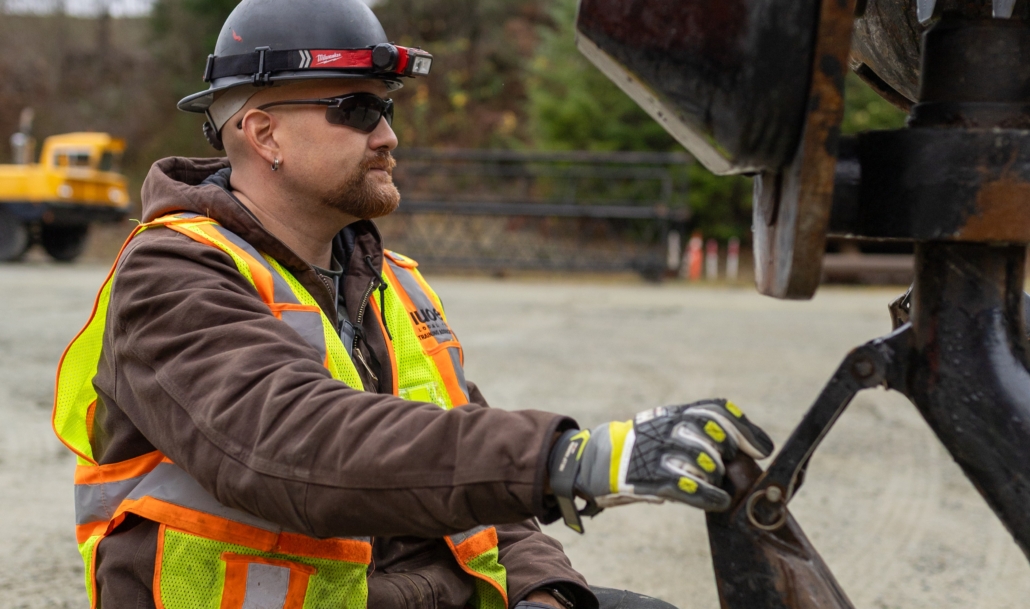
A supervisory role is crucial on a jobsite to make sure production flows smoothly and workers stay safe. A supervisor is defined by WorkSafeBC as “a person who instructs, directs and controls workers in the performance of their duties”.
Contrary to popular belief, workers don’t necessarily need to have the word “supervisor” in their title to be considered a supervisor under this regulatory definition. Supervisors can be any worker, regardless of title, so long as they meet the definition outlined above.
Supervisors need to be knowledgeable about the specific jobs and tasks they perform and the tasks they instruct others to perform.
They are also required by the Workers Compensation Act to be knowledgeable about the occupational health and safety provisions and regulations applicable to the work being supervised.
Supervisors are responsible not only for their own actions, but also for the actions and conditions under their watch that directly affect worker safety and their organization’s status and reputation.
The large reach of a supervisor’s on-the-job responsibilities may seem daunting.
Setting up a supervisor for success requires a strong understanding of their key responsibilities to clearly define their role.
Basic supervisor responsibilities include:
- Ensuring the health and safety of all workers under their direct supervision.
- Knowing WorkSafeBC requirements that apply to the work under their supervision and ensuring those requirements are met.
- Ensuring that workers under their supervision are aware of all known hazards.
- Ensuring that workers under their supervision have the appropriate personal protective equipment and that it is being used properly, regularly inspected, and maintained.
- Complying with occupational health and safety provisions, applicable regulations, and any orders issued by the regulator.
- Consulting and cooperating with their organization’s Joint Occupational Health and Safety Committee or worker health and safety representative.
- Cooperating with the Board, officers of the Board and any other person carrying out a duty under the occupational health and safety provisions or regulations.
While a supervisor holds an incredible amount of responsibility, it is a supervisor’s employer who must ensure that the right qualified person is assigned the role.
WorkSafeBC defines “qualified” as “being knowledgeable of the work, the hazards involved, and the means to control the hazards, by reason of education, training, experience or a combination thereof.”
Supervisors and their employers should be able to clearly communicate and prove why a person is in their supervisory position.
Learn more about roles, rights, and responsibilities by visiting our knowledge base page.
Q&A
Question: How do I view my crane operator credentials in the SkillRecord Passport app?
Answer: When you register with BC Crane Safety, you are also creating a SkillRecord Passport account. Within the free SkillRecord Passport app, you can view your current BC Crane Safety credentials.
In the Settings tab, click on My Credentials to view your active crane certificates. Soon you will also have the option to add your digital credential card(s) to your Apple or Google Wallet from this screen.
An internet/data connection is needed to view the digital cards, so we suggest that operators take a screenshot of their credential to always have it handy when working in areas without service.
Question: What’s the difference between my BC Crane Safety ID number and my crane operator certificate number?
Answer: A BC Crane Safety ID number, issued by BC Crane Safety, is a personal identification number assigned to an operator upon registration through the BC Crane Safety website. This number is required before applying for any crane certification in B.C. However, it is NOT a certificate.
The BC Crane Safety ID number begins with four digits showing the year of registration followed by a hyphen and additional numbers (e.g., 2026-12345)
A crane operator certificate number is a unique credential number issued for a specific crane classification. It represents the operator’s qualification for that type of crane.
To be compliant to operate a crane in B.C., a crane operator must have both a valid BC Crane Safety number and a current certificate for the specific crane they are operating.
Question: Who should apply for a DEP (Dedicated Emergency/Evacuation Platform) Endorsement?
Answer: Applications for the DEP endorsement should be submitted by the crane operator’s sponsoring employer as they are responsible for the operator’s certification in the provisional (learner) stage. Operators can apply for a DEP Endorsement as long as the documents are signed-off by their sponsoring employer and available for review. General contractors should only be submitting a DEP Endorsement application on behalf of an operator if they are the provisional operator’s sponsoring employer.
More information can be found on our Dedicated Emergency Platform / Dedicated Evacuation Platform (DEP) knowledge base page.